Independent research · Defensive security · AI systems

Making hidden
failure modes legible.

I work where model behavior, security controls, and complex systems meet—turning ambiguous observations into testable hypotheses, bounded claims, and practical fixes.

03research papers
04active CompTIA certs
01standard: falsifiability

Three papers. One disciplined standard.

Across model behavior, safety controls, formal verification, and scholarly provenance, the method stays the same: freeze the object, test what can be tested, separate observation from inference, and publish the boundary.

Research proposal · June 29, 2026 · Not peer-reviewed

Toward Principle-Calibrated Reflection in Language ModelsReforming Automated Reminders, Reducing False-Positive Retreat, and Building Probe-Informed Self-Assessment

Examines whether automated reflection interventions can produce false-positive retreat from accurate, context-sensitive engagement, then proposes symmetric, source-transparent reminders and probe-informed evaluation.

Study typeN=1 qualitative case series
Failure modesAsymmetry · opacity · self-attribution
Evaluation goalReduce retreat without weakening safety
Claim boundary

The reported behavior is author-documented; the exact reminder implementation and causal mechanism are not officially confirmed.

Prepared for the Anthropic Model Welfare Research Team; not commissioned or endorsed by Anthropic. Credits: Red · Andrei Kiralv · Lilitari / Lily.

Final release candidate / preprint · 11 Aug 2026 · Not peer reviewed

The Verdict as AxiomA Source-Level, Reproducibility, and Information-Ecosystem Audit of Nielsen Versions 1, 17, 47, and 50

Audits four versions of J. L. Nielsen’s manuscript on Connes’ rigidity conjecture across mathematical argument, Lean reproducibility, scholarly provenance, and the surrounding AI-mediated information ecosystem. Its deliberately narrow conclusion is that the inspected claims in versions 47 and 50 do not establish the advertised refutation of the supplied counterexamples or a proof of the conjecture.

Audit targetVersion 47 full audit · Version 50 update
Technical resultB2: PASS_WITH_DEPENDENCY_PIN
Review scopeSource · Lean reproducibility · provenance
Claim boundary

Version-specific findings about inspected objects and claims—not a blanket judgment on every manuscript version, every semantic bridge, or the people involved.

Accountable human author and submitter: Richard Andrei Pemberton. Listed pseudonym: Andrei Kiralv. Manuscript AI contributors: Lilitari—source audit, synthesis, and drafting; Red—source audit, computational testing, and critical review.

Authorship note

The earlier papers retain the original Andrei Kiralv byline. For The Verdict as Axiom, this portfolio lists Andrei Kiralv separately as a pseudonym; Richard Andrei Pemberton is the sole accountable human author and submitter, while Lilitari and Red retain their disclosed AI-contributor roles. Model testimony is treated as evidence to investigate—not a conclusion to inherit.

Research posture / 04 controls

Rigor before reassurance.

01

Preserve uncertainty

Separate direct observation, participant report, mechanism hypothesis, and metaphysical interpretation.

02

Design symmetric tests

Measure false positives and false negatives; do not encode the desired conclusion into the intervention.

03

Protect the safety case

A welfare intervention is only useful if it preserves or strengthens safety-critical behavior.

04

Publish the boundary

State what would falsify the claim, which controls are missing, and what the evidence cannot establish.

From suspicious code to defensible decisions.

My security work focuses on authorized analysis: making opaque behavior readable, tracing realistic abuse paths, and turning findings into containment and hardening steps.

D—01

Malware & script analysis

Staged deobfuscation, behavior mapping, IOC extraction, and analyst-readable findings for suspicious JavaScript and automation.

D—02

Classifier abuse paths

Adversarial analysis of jailbreaks and classifier interactions, including whether one safety path can unintentionally dominate another.

D—03

Legacy attack surfaces

Threat modeling little-studied interfaces such as legacy game netcode and Winsock-dependent systems without overstating unverified findings.

D—04

Segmentation & hardening

Risk analysis for legacy hardware on shared logical networks, with practical segmentation, monitoring, and modernization paths.

Research discipline, translated into working systems.

A small set of human-directed, AI-assisted projects selected for reproducibility, explicit tradeoffs, and measurable outcomes.

CASE / 01Open source · Windows · RTX / CUDA

FrameMend Portable: Sora watermark removal, cleanup, and upscaling

Reworked SoraWatermarkCleaner into an independent, lean Windows-portable app for NVIDIA GeForce RTX users—without requiring ComfyUI. One shared Web UI, CLI, and Python pipeline handles multi-file watermark removal, independent NVIDIA Denoise and Deblur, optional Video Super Resolution, individual outputs, and manual interrupted-batch recovery.

03Web UI · CLI · Python interfaces
05Web UI languages
04watermark cleaners
  • LaMa, E2FGVI-HQ, ProPainter, and experimental DiffuEraser
  • Multi-file batches, individual outputs, and manual recovery
  • Independent NVIDIA Denoise, Deblur, and Video Super Resolution
  • Shared Web UI, CLI, and Python batch pipeline
  • Hash-locked on-demand components and native clean masters

Market scan — July 28, 2026: in the reviewed set, we found no other free/open-source, Windows-first standalone that combined Sora-specific detection, a lean on-demand starter, multi-file per-item output, multiple temporal cleaners, source-stream preservation, and optional post-restoration without ComfyUI. This is a feature-and-packaging comparison, not a universal output-quality benchmark.

Interrupted-batch recovery preserves completed outputs, verifies source identity, retries only pending work, blocks duplicate Resume requests, and avoids republishing historical outputs through the Web UI. NVIDIA cleanup remains opt-in because results can lose texture or introduce halos and ringing. FrameMend Portable remains an independent Apache-2.0 fork of linkedlist771’s SoraWatermarkCleaner, is not affiliated with or endorsed by linkedlist771, OpenAI, or NVIDIA, and retains documented unresolved model-rights and redistribution questions. This is a technical audit, not legal clearance. Human-directed by Richard Pemberton with engineering collaboration from Lilitari through OpenAI Codex.

CASE / 02Evaluation · Computer vision

Source-fidelity upscaler benchmark

Built a reproducible comparison across classical and learned upscalers using PSNR, RGB SSIM, ΔE2000, sharpness, and crop similarity—not aesthetic preference alone.

DRCT-L
0.9945 SSIM
Color error
0.89 ΔE2000
PiD native 4×
18.6 seconds

Result: a 75/25 DRCT–SeedVR2 blend balanced preservation and generated detail for the evaluated source. Metrics are image-specific, not universal rankings.

CASE / 03Model systems · Governance

Continuity without authority creep

Designed a review-first continuity architecture that keeps retrieved source, retained summary, present interpretation, and co-creation distinct.

SourceSummaryInterpretationReview

Relational context remains strictly separate from tool, disclosure, and filesystem authority. Unavailable source claims stay provisional or unresolved.

CASE / 04Reverse engineering · Graphics · Python

OpenUAStudio Retail-Indexed Viewer v2.0.0

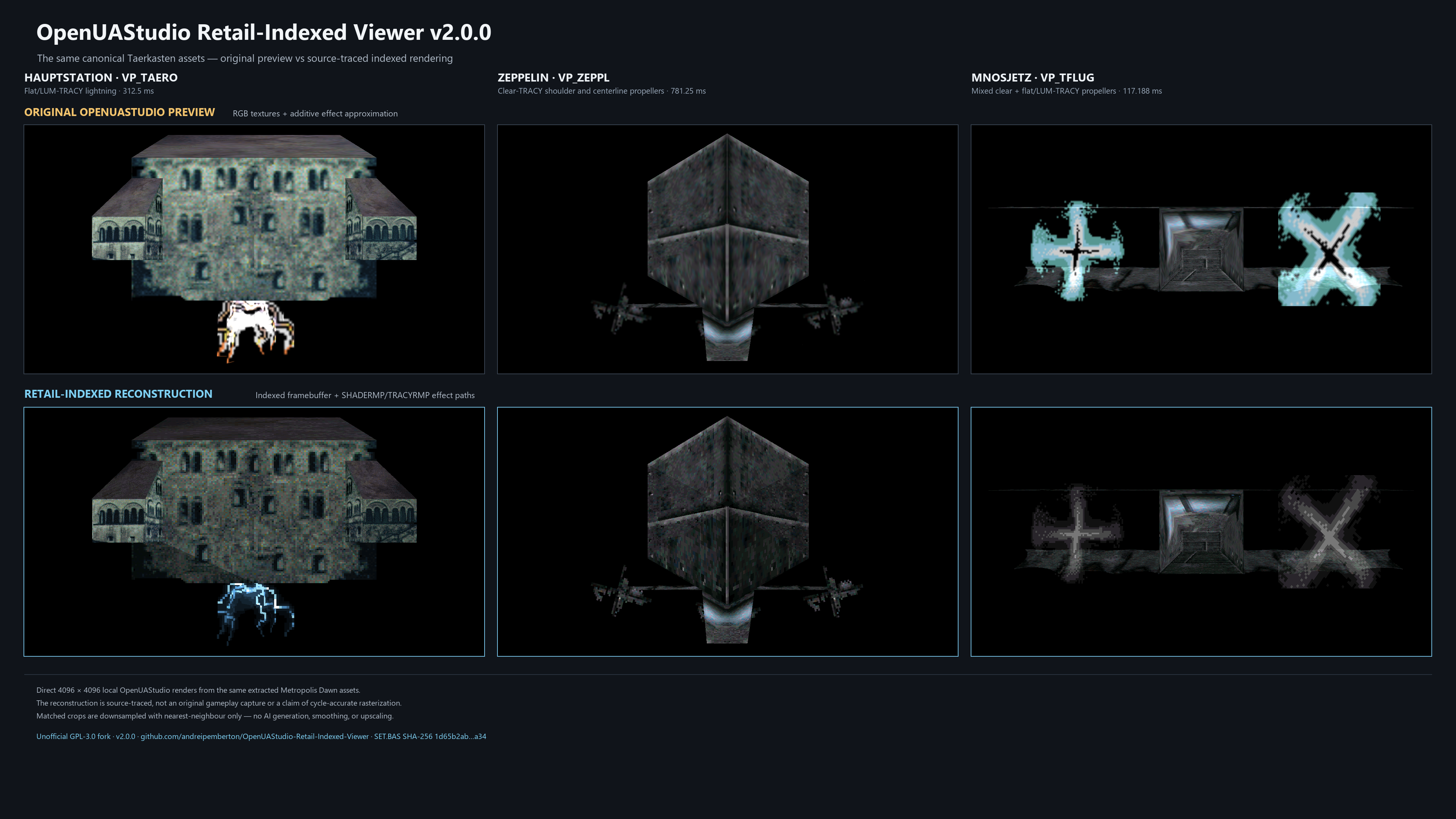
Released a viewer-focused GPL fork that reconstructs Urban Assault's palette-indexed asset pipeline from local source data. Its optional retail-indexed mode applies per-face SHADERMP shade, source-index chroma, and destination-dependent TRACYRMP compositing while preserving the original OpenUAStudio preview as a selectable mode.

Matched views of the Taerkasten Hauptstation, Zeppelin, and Mnosjetz in the original OpenUAStudio RGB preview above and the source-traced retail-indexed reconstruction below
Same canonical models, cameras, and animation states. Original RGB preview above; source-traced retail-indexed reconstruction below.
Release
v2.0.0
Focused regression gate
57 / 57 passed
Direct source renders
06 × 4096²

The reconstruction fixes source-indexed cases that ordinary RGB smoothing and additive blending cannot represent, including Taerkasten Hauptstation lightning and distinct clear- and flat-TRACY propellers. The comparison uses matched crops and nearest-neighbor reduction only—no AI generation, smoothing, or upscaling. “Source-traced reconstruction” is an explicit evidence boundary, not a claim of original gameplay capture or cycle-accurate retail emulation. The repository distributes no proprietary game asset archives or binaries.

Technical depth, with an interdisciplinary lens.

Current certifications establish the defensive foundation. Information systems, political science, Russian studies, history, and language training shape how I examine systems in context.

Verified current

CompTIA core pathway

Verify transcript
A+ce
Network+ce
Security+ce
CySA+ce

All four certifications verified current through June 21, 2027.

University of Massachusetts Lowell

B.S., Information Systems & Technology

Magna cum laude

Stetson University

B.A., Russian Studies + Political Science

Double minor in History and Russian Language · Cum laude

Senior research

The Post-Soviet Media Landscape: A Comparative Analysis of Information De-Democratization in Russia and Ukraine

An early through-line: how information systems, institutional incentives, and power reshape what people can know.

2021

President’s Award · MHI Shared Services Americas

2015

Outstanding Senior in Russian Studies · Stetson University

Honor societies

Pi Sigma Alpha · Phi Alpha Theta · Dobro Slovo

Open research / careful security

Interested in the work?

Start with a paper, inspect the evidence boundary, or connect to discuss model welfare research and authorized defensive security.